Introduction
What if your plants could text you when they need water? Or your home lights could turn on automatically before you even walk through the door?
One thing I’ve noticed while working on electronics projects is that the most exciting builds aren’t always the most complex ones. Sometimes, a simple microcontroller combined with sensors and internet connectivity can create surprisingly powerful solutions.
From smart home automation and weather monitoring to security systems and remote-controlled devices, the possibilities are almost endless. Similar project categories remain popular among Arduino and IoT enthusiasts because they combine practical functionality with hands-on learning.
In this article, I’ll explore five powerful IoT microcontroller ideas that are practical, beginner-friendly, and perfect for anyone looking to build smarter electronic projects.
For a deeper understanding of IoT systems, explore how they differ from traditional setups in our article on the Differences Between IoT and Embedded Systems.
What Are Microcontrollers in IoT?
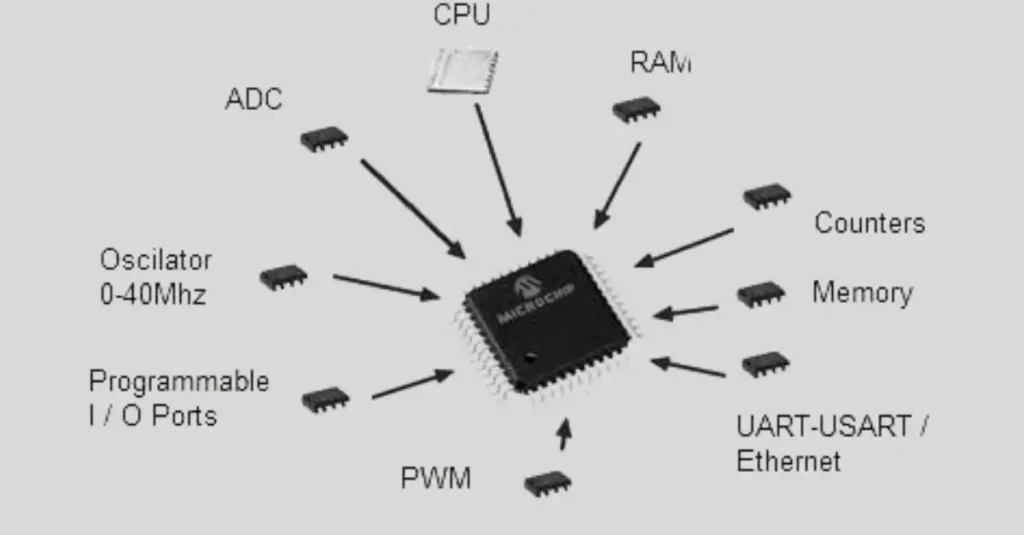
Microcontrollers are compact integrated circuits designed to perform specific tasks. They act as the “brain” of IoT devices, handling input from sensors, processing data, and triggering actions. Unlike microprocessors, microcontrollers integrate memory, processors, and input/output peripherals, making them perfect for IoT applications.
Top 10 IoT Microcontroller Ideas
- Smart Home Automation
Build systems for lighting, temperature control, and security. For instance, use ESP8266 to create a voice-controlled lighting system. - Wearable Devices
Fitness trackers and heart rate monitors are powered by microcontrollers like the Arduino Nano, ideal for compact projects. - Agricultural Sensors
Monitor soil moisture, temperature, and weather using microcontrollers like ESP32 for precision farming. - Industrial IoT (IIoT)
Predictive maintenance and equipment monitoring can save industries millions. STM32 microcontrollers are perfect for robust industrial environments. - Smart Cities
Use microcontrollers to manage energy-efficient streetlights and smart traffic systems.
Table :
| IoT Application | Recommended Microcontroller | Key Features |
|---|---|---|
| Smart Home | ESP8266 | Wi-Fi Enabled, Compact |
| Wearables | Arduino Nano | Low Power, Small Form |
| Agriculture | ESP32 | Low Power, High Connectivity |
Ready to get hands-on? Start with our list of IoT Beginner Projects to bring your ideas to life.
How to Choose the Right Microcontroller
When selecting a microcontroller for your IoT project, consider:
- Processing Power: ESP32 for high performance, Arduino Uno for basic tasks.
- Connectivity: Opt for Wi-Fi or Bluetooth-enabled controllers.
- Power Efficiency: Choose low-power options for battery-operated devices.
Comparison Table of Popular IoT Microcontrollers
| Microcontroller | Connectivity | Power Consumption | Processing Power | Memory | Best For |
|---|---|---|---|---|---|
| ESP8266 | Wi-Fi | Low | 80 MHz, Tensilica L106 | 64 KB RAM, 4 MB Flash | Budget IoT projects with Wi-Fi connectivity |
| ESP32 | Wi-Fi, Bluetooth | Low | Dual-core, 240 MHz | 520 KB RAM, 4 MB Flash | Advanced IoT applications needing Wi-Fi and Bluetooth |
| Arduino Uno | None (add-on modules) | Moderate | 16 MHz, ATmega328P | 2 KB RAM, 32 KB Flash | Basic IoT projects, prototyping |
| STM32 | Ethernet, CAN, USB | Very Low | Up to 480 MHz (High-end models) | Up to 1 MB RAM, 2 MB Flash | Industrial IoT, real-time applications |
| Raspberry Pi Pico | None (add-on modules) | Low | Dual-core, 133 MHz | 264 KB RAM, 2 MB Flash | Low-power IoT devices, prototyping |
| Nordic nRF52 | Bluetooth, Zigbee | Ultra Low | 64 MHz, ARM Cortex-M4 | 256 KB RAM, 1 MB Flash | Wearables, Bluetooth applications |
| TI CC3200 | Wi-Fi | Low | 80 MHz, ARM Cortex-M4 | 256 KB RAM, 1 MB Flash | IoT sensors, Wi-Fi-enabled projects |
Security and Power Management in IoT
IoT devices are prone to cyber threats. Implement security protocols like encryption, secure boot, and regular firmware updates. For power management:
- Use sleep modes to extend battery life.
- Integrate energy-efficient components like STM32 microcontrollers.
Future Trends in IoT with Microcontrollers
The future of IoT is bright:
- AI Integration: Microcontrollers will process data locally, reducing latency.
- 5G Connectivity: Enhanced speeds for real-time communication.
- Sustainability: Energy-efficient designs are on the rise.
Conclusion
The best thing about IoT projects is that they turn ordinary ideas into smart solutions. What starts as a simple microcontroller project can evolve into a device that automates tasks, improves efficiency, or even solves everyday problems.
When I first started exploring IoT, I was surprised by how a few sensors, a microcontroller, and an internet connection could create something genuinely useful. Whether you build a smart home system, weather station, or security project, each project teaches valuable skills while giving you something practical to use.
The hardest part isn’t building the project it’s deciding which idea to start with first.
FAQs
-
What is the best microcontroller for IoT projects?
ESP32 for high connectivity; STM32 for industrial-grade tasks.
-
Can IoT devices work offline?
Yes, using microcontrollers with built-in storage and local processing.