At first glance, the colourful bands on a resistor might look like random stripes with no meaning. I remember feeling the same way when I first started learning electronics. I had no idea that those tiny colors could reveal a resistor’s resistance, tolerance, and even other important specifications.
In this beginner-friendly guide, I’ll explain how to read resistor color codes, decode 4-band, 5-band, and 6-band resistors, and share simple tips to help you identify resistor values with confidence. Resistor colour bands are an internationally standardized way to indicate resistance values and tolerance on through-hole resistors.
If you’re new to resistors and want to understand their basics, check out our Introduction to Resistors: A Beginner’s Guide.
What is Resistor Colour Coding?
Resistor color coding is a universal system where each resistor has a set of colored bands that indicate its resistance value, multiplier, and tolerance. This system was developed by the Radio Manufacturers Association (RMA) in the 1920s and later standardized by the Electronic Industries Association (EIA).
Each color represents a specific digit, making it easy to decode the resistance value using a color chart.
Want to learn how to read resistor color codes quickly? Watch our step-by-step video tutorial to understand 4-band and 5-band resistors, color-band values, multipliers, and tolerance.
Watch the tutorial:
Types of Resistor Color Coding
Now, the commercially available resistors can have either four, five, or six bands, depending on the number of color bands. These resistors are known as either four-band, five-band, or six-band resistors.
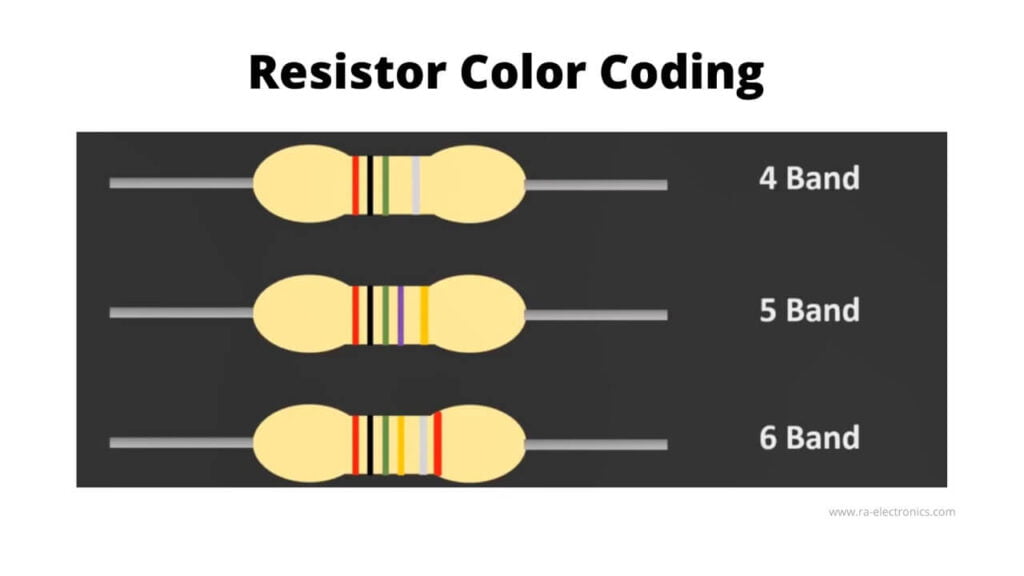
1. 4 Band Resistor
Let us find out how to find the value of these four-band resistors.
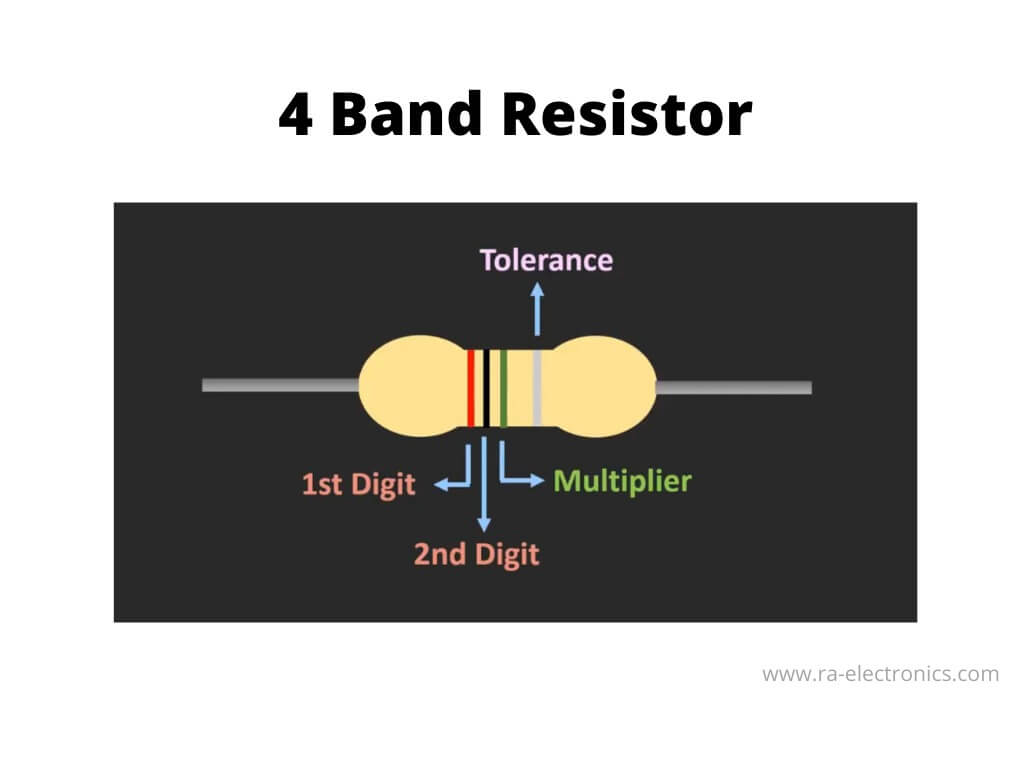
If you look at a four-band resistor, you’ll notice four color bands on it. Here’s what each band represents:
- First two bands → These give you the first two digits of the resistance value.
- Third band → This acts as a multiplier, telling you how many zeros to add.
- Fourth band → This shows the tolerance, meaning how much the actual resistance can vary.
The resistance value changes based on the colors of these bands.
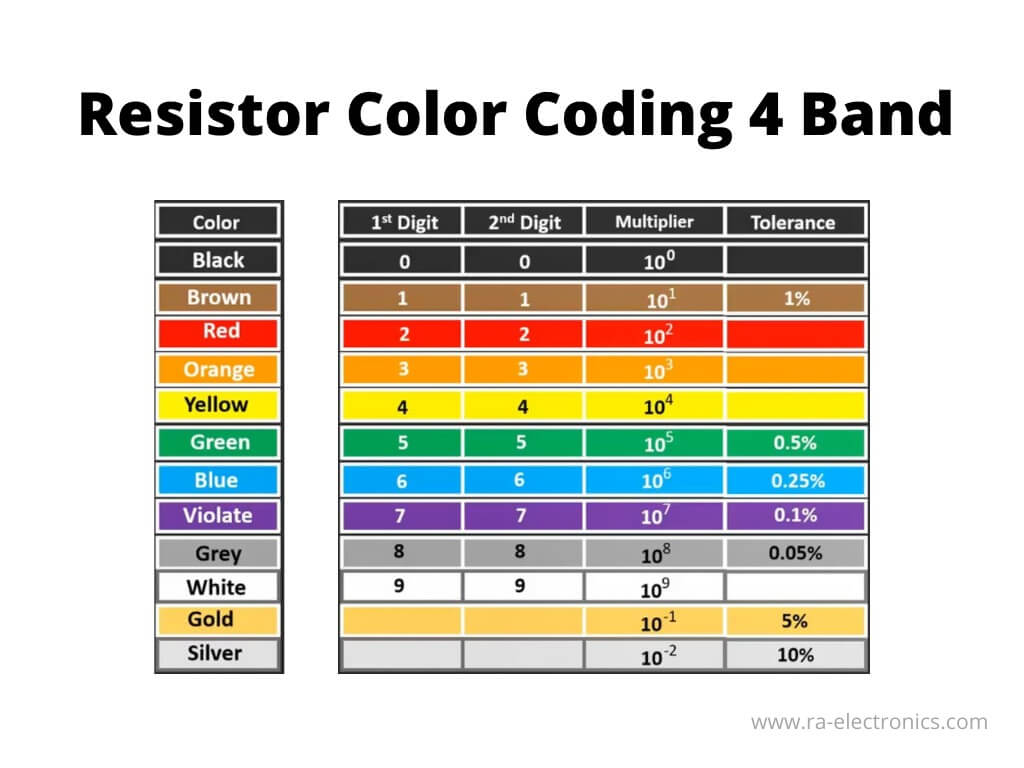
Now, let’s break down what each color represents and how it helps determine the resistor’s value. Check out the table below!
How to Read 4-Band Resistors
As you can see in the table below, the first two columns represent the first two color bands of the resistor. The value of these bands determines the first two digits of the resistance.
Similarly, the next two columns show the multiplier and tolerance. These values also change based on the colors of the bands.
By using this table, you can easily decode the resistance value of any resistor!
Example: Reading a 4-Band Resistor
Let’s say you have a 4-band resistor with the following colors:
🟢 Green | 🔴 Red | 🟡 Yellow | 🏅 Gold
Step-by-Step Calculation:
1️⃣ Green (5) → First digit
2️⃣ Red (2) → Second digit
3️⃣ Yellow (×10,000) → Multiplier
4️⃣ Gold (±5%) → Tolerance
Final Resistance = 52 × 10,000 = 520,000Ω (or 520kΩ) ±5%
This means the actual resistance can vary between 494kΩ and 546kΩ.
This is how you quickly read a 4-band resistor using color coding!
2. 5 Band Resistor
Now, let us find out how to find the value of the resistor when it has a five-colour band.
How to Read 5-Band Resistors
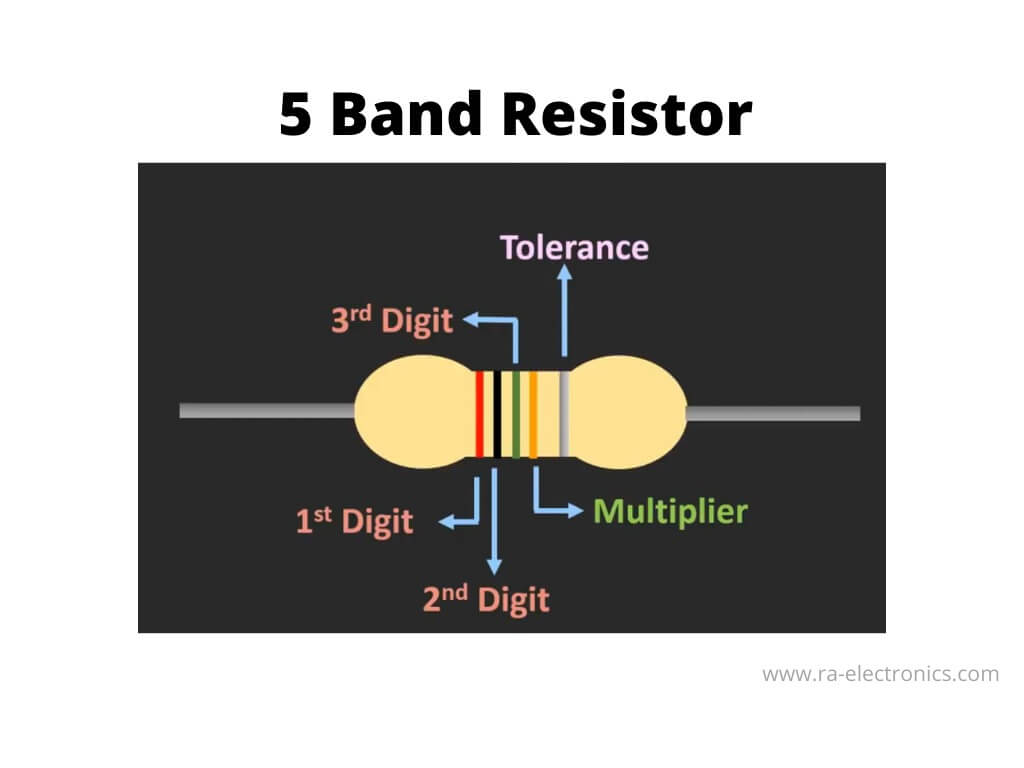
For a 5-band resistor, the color bands are interpreted as follows:
- First three bands → Represent the first three digits of the resistance value.
- Fourth band → Acts as a multiplier, determining how many zeros to add.
- Fifth band → Indicates the tolerance, showing how much the actual resistance can vary.
The table below provides a clear breakdown of each color’s value, including the digits, multiplier, and tolerance based on the resistor’s color bands. This makes it easy to calculate the exact resistance!
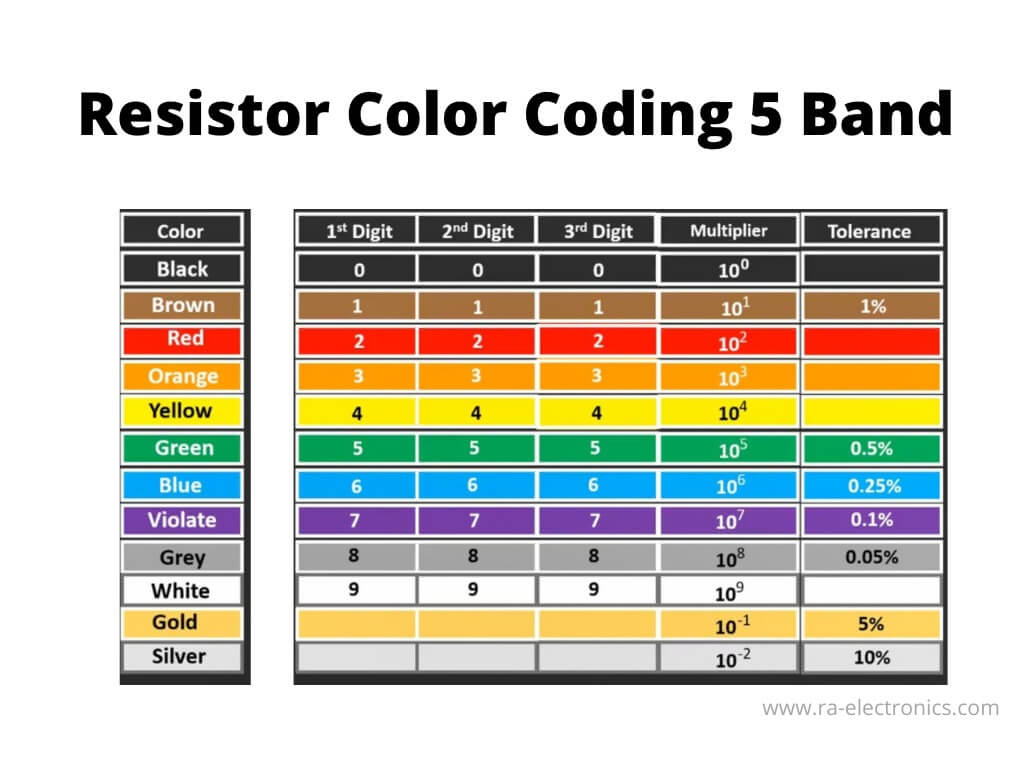
Example: Reading a 5-Band Resistor
Let’s say you have a 5-band resistor with the following colors:
🔵 Blue | 🟠 Orange | 🟡 Yellow | ⚫ Black | 🥈 Silver
Step-by-Step Calculation:
1️⃣ Blue (6) → First digit
2️⃣ Orange (3) → Second digit
3️⃣ Yellow (4) → Third digit
4️⃣ Black (×1) → Multiplier
5️⃣ Silver (±10%) → Tolerance
Final Resistance = 634 × 1 = 634Ω ±10%
This means the actual resistance can vary between 570Ω and 697Ω.
This is how you accurately determine the resistance of a 5-band resistor using color coding!
3. 6 Band Resistor
6-band resistors are not commonly used in general-purpose circuits but are essential for specialized applications like precision electronics and military-grade equipment.
Here’s how the color bands work in a 6-band resistor:
- First three bands → Represent the first three digits of the resistance value.
- Fourth band → Acts as the multiplier, determining how many zeros to add.
- Fifth band → Indicates the tolerance, showing the possible variation in resistance.
- Sixth band → Represents the Temperature Coefficient of Resistance (TCR), which tells how much the resistance changes with temperature.
Since these resistors offer high precision and stability, they are widely used in aerospace, military, and high-end electronic devices.
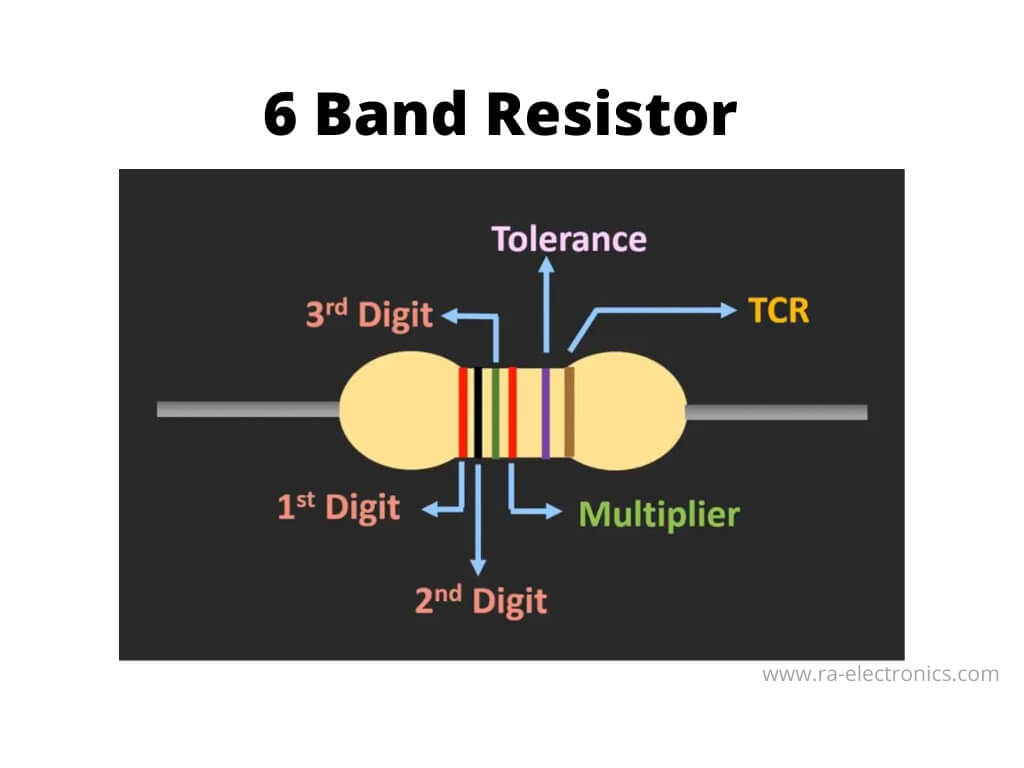
Here is a table from which we can find the value of the individual digits as well as the value of the multiplying factor.
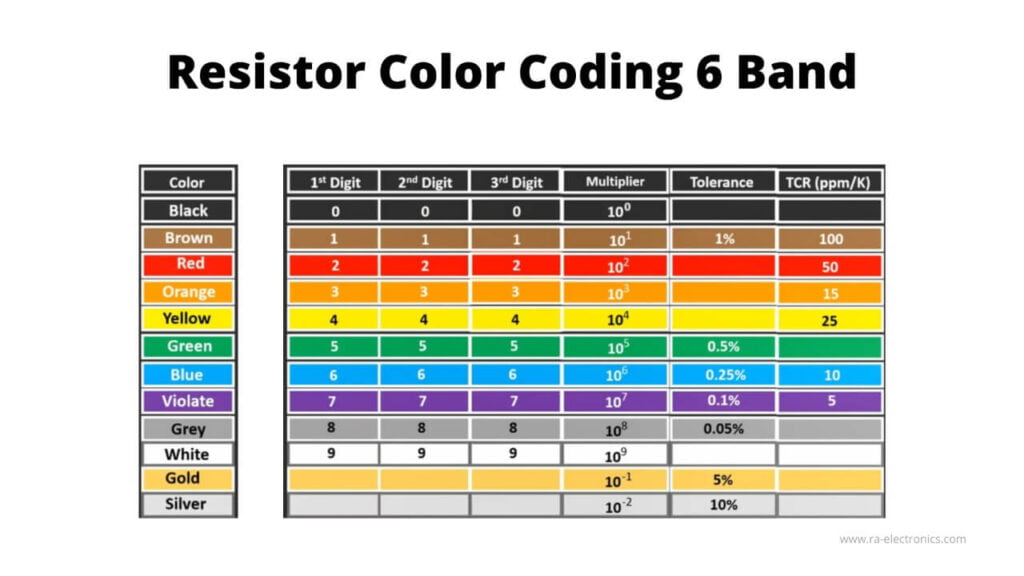
Example: Reading a 6-Band Resistor
Let’s say you have a 6-band resistor with the following colors:
🟢 Green | 🔵 Blue | 🟠 Orange | 🔴 Red | 🤎 Brown | 🔵 Blue
Step-by-Step Calculation:
1️⃣ Green (5) → First digit
2️⃣ Blue (6) → Second digit
3️⃣ Orange (3) → Third digit
4️⃣ Red (×100) → Multiplier
5️⃣ Brown (±1%) → Tolerance
6️⃣ Blue (10 ppm/°C) → Temperature Coefficient
Final Resistance = 563 × 100 = 56,300Ω (or 56.3kΩ) ±1%
This means the actual resistance can vary between 55.7kΩ and 56.9kΩ.
The TCR of 10 ppm/°C means the resistance changes by 10 parts per million per degree Celsius.
This level of precision and stability makes 6-band resistors ideal for high-reliability applications like aerospace and military electronics!
When I first began working with resistors, I kept checking a color code chart because I couldn’t remember what each color represented. After decoding a few resistors during small electronics projects, the process became much easier. I realized that understanding the pattern was far more useful than trying to memorize every color from the start.
If you’re new to electronics, don’t worry if the color bands seem confusing at first. With a little practice, you’ll be able to identify resistor values in just a few seconds.
Conclusion: Why You Should Master Resistor Color Coding
Every electronics enthusiast starts by wondering what those colored bands mean. The good news is that once you learn the resistor color code, identifying resistor values becomes quick and intuitive.
Whether you’re repairing a circuit, building your first DIY project, or simply learning electronics, understanding resistor color coding is a small skill that makes a big difference. The more you practice reading resistor bands, the more confident you’ll become when working with electronic components.
For quick calculations or verifying resistor values, try our online resistor calculator. With this knowledge and the right tools, you’ll be able to work with resistors confidently in any electronic circuit.
If you’re working on circuits and need a platform to build them, learn more in our Beginner’s Guide: Introduction to Breadboards.
FAQs for Resistor Color Coding
-
How do I read resistor color codes?
Identify the first two digits, apply the multiplier, and check the tolerance band. Use a resistor colour code chart for reference.
-
What does the gold band mean on a resistor?
A gold band indicates ±5% tolerance, meaning the actual resistance can vary within that range.
-
What do the different colors on a resistor indicate?
The different colors on a resistor indicate the value and tolerance of the resistor. Each color corresponds to a specific number or multiplier. For example, the color brown represents the number 1, and the color red represents the number 2.
-
What is the tolerance of a resistor?
The tolerance of a resistor is a measure of how closely the actual resistance value of the resistor matches the rated resistance value.
-
Can I measure the resistance of a resistor using a multimeter?
Yes, you can measure the resistance of a resistor using a multimeter. Set the multimeter to the resistance measurement mode and touch the multimeter leads to the two ends of the resistor.